We tested 53 of the UK's biggest retailers to see what an AI shopping agent actually finds.
1 of 53
publishes anything at all written for agents to read
12
of 53 would not show an identified audit client even robots.txt, the file that states the rules
5
name and restrict AI agents in the robots.txt files we could read
2 of 19
shelves we could compare answered the same product URL differently by client
The finding is not that the high street blocks AI. It is stranger: the same URL gives different answers depending on who is asking, and almost nobody has written the rules down.
Get a free Agent Visibility Snapshot
Enter your domain for an automated check of selected public signals: what your site states for agents, whether one discovered page is readable, and whether it exposes basic offer details. This limited Snapshot is not the six-dimension Agent Visibility Score v1.0 assessment.
No sign-up. The Snapshot is a point-in-time automated screen, not a ranking, certification or full AVS result. Read the v1.0 methodology and its limits. Refusals are reported as facts about our requests, not claims that a site blocks AI agents.
Designed PDF editions, delivered straight after checkout · VAT invoice issued automatically · or buy by invoice
How we tested. We asked each retailer's website for one product page, three times over, introducing ourselves differently each time: once as an openly declared research robot, once looking like an ordinary web browser, and once as a generic shopping assistant. We never pretended to be human, never tried to get past anyone's security, and kept a tamper-evident record of every answer.
What we found. The same page can treat each visitor completely differently. One retailer's product page, asked three times in the same minute, refused the first of us, challenged the second, and gave the third the complete page, price included. And almost no retailer states anywhere what its rules for AI shoppers actually are. That is what an AI agent shopping on your customer's behalf runs into.
What we learned
Access to the UK machine shelf is not a wall. It is a lottery, and the ticket is your user agent string.
Nothing in any retailer's stated policy predicts which of those answers a visitor gets. That is the pattern the index keeps finding, and it matters because the infrastructure is arriving first. Agent checkout protocols, delegated payment specifications and universal cart initiatives are live programmes at the platform and payment layer, while the retail surfaces they need to read remain inconsistent, unstated and largely unstructured. A machine customer is a third commercial surface: not the store, not the website, but the connected evidence and authority that let software represent a customer safely. Very little of the high street is designed for it.
The UK shelf is not ready to be read.
And when a page is served, being readable is not the same as being trustworthy. A price can be visible but undated. A promotion can lack its conditions. Identity can be ambiguous between pack sizes. A machine will carry each of those ambiguities forward at machine speed, into someone's basket.
THE DEFENSIBLE CONCLUSIONThe evidence is consistent with systemic under-preparedness of the public UK retail machine shelf. It does not prove that every retailer, every model or every authenticated channel fails, and we do not claim that any retailer blocks AI agents.
The scale of the shift
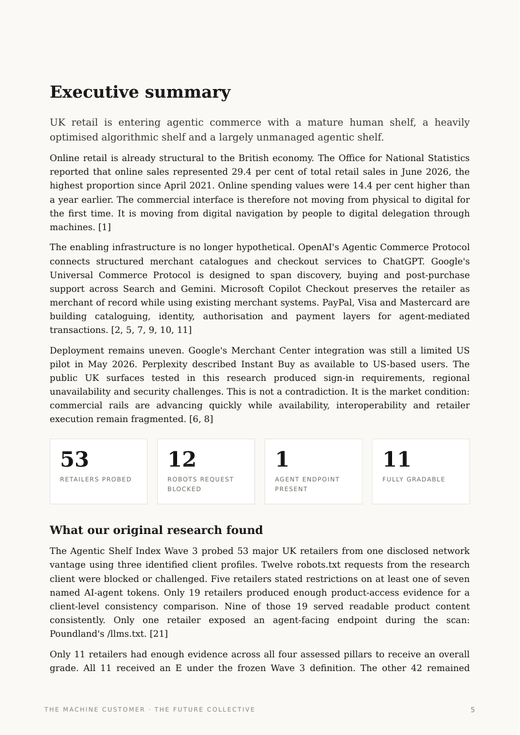
Online is no longer a channel; it is approaching a third of UK retail. The Office for National Statistics put internet sales at 29.4 per cent of all retail sales in June 2026, the highest share since April 2021, with online sales values growing 14.4 per cent year on year. That is the shelf a machine customer reads first, and it is where delegated buying will land.
The buying side is being built now. OpenAI has published a delegated payment specification for agent checkout, Google is expanding a universal cart across its shopping surfaces, and PayPal is syncing merchant catalogues for agent discovery. Those rails assume the shelf can be read.
Wave 3 suggests the UK shelf is not ready to be read: of 53 major retailers, one publishes anything written for agents at all.
THE COMMERCIAL EXPOSUREWhen a machine customer cannot find, read or trust a shelf, the sale does not fail politely. It goes to whichever competitor the agent could read, and nobody at the losing retailer sees the customer they never met.
What we measure
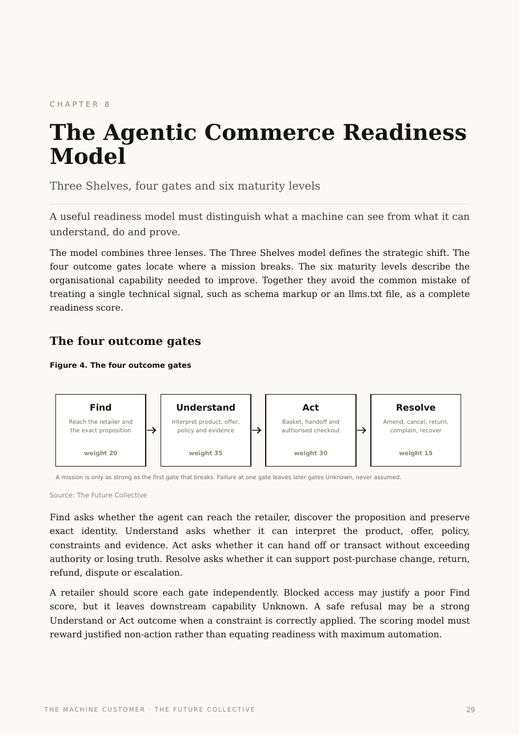
Four things have to be true, in order, before an agent can shop a retailer. The index measures each from the public web, with the same access an agent has, and refuses to invent a score where the evidence chain is incomplete. This is not SEO or GEO by another name: whether a model mentions your brand in an answer is one question; whether a machine acting for a customer can reach your shelf, read the price and act on it is a different one, and it is the second that carries a transaction.
Access
What robots.txt states about named AI agents, and whether the same product URL answers every disclosed client alike. Stated policy and observed consistency; never a "blocked" verdict.
Read
schema.org product markup, structured price, stock and identifiers an agent can parse, judged only on pages that were actually served.
Trust
Price visible without sign-in, member prices disclosed, offer validity dated.
Transact
Agent-facing endpoints, guest checkout, deep links into a basket. Checkout facts need a person, so they are attested or disclosed as unassessed.
A SEPARATE METHODThe Agent Visibility Score v1.0 expands the research to six dimensions, adding Discover and Recommend, with a fixed multi-system panel, evidence coverage and independent review. It is in controlled pilot and is not the same as the four-gate Agentic Shelf Index or the free Snapshot. Read the full methodology.
Why there is no league table on this page
Under our published method, a ranked claim about named retailers needs near-complete coverage, repeated observation and second review. Wave 3 does not meet that bar: from one disclosed vantage, only 19 of 53 shelves could even be compared like for like. Publishing a league table on that evidence would be theatre, and theatre is exactly what the machine shelf does not need. So the index publishes what it can defend: the aggregate state of the market, the method, and the recorded evidence of our own requests. For each of the 53, the full record of how their shelf answered our clients exists, request by request; it is disclosed to the retailer concerned within an engagement.
Three ways to act on it
Flagship research report
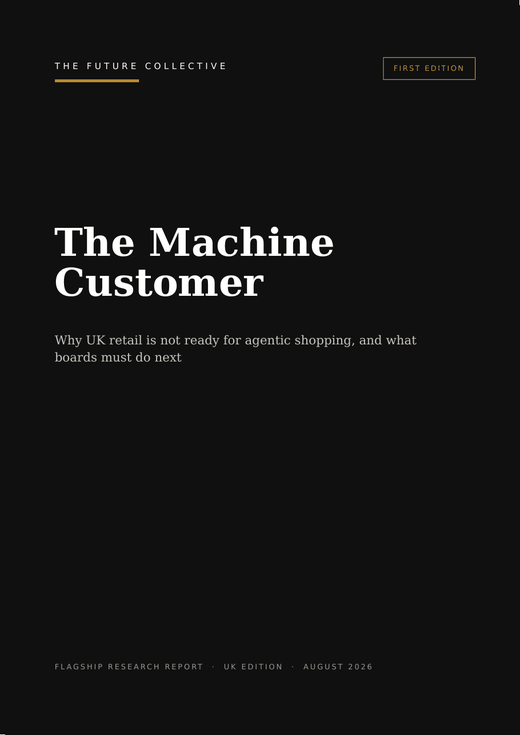
The Machine Customer
Why UK retail is not ready for agentic shopping, and what boards must do next. The full evidence base behind this index: the 53-retailer scan, a medicines case study, the readiness model and the board agenda. First edition, designed PDF.
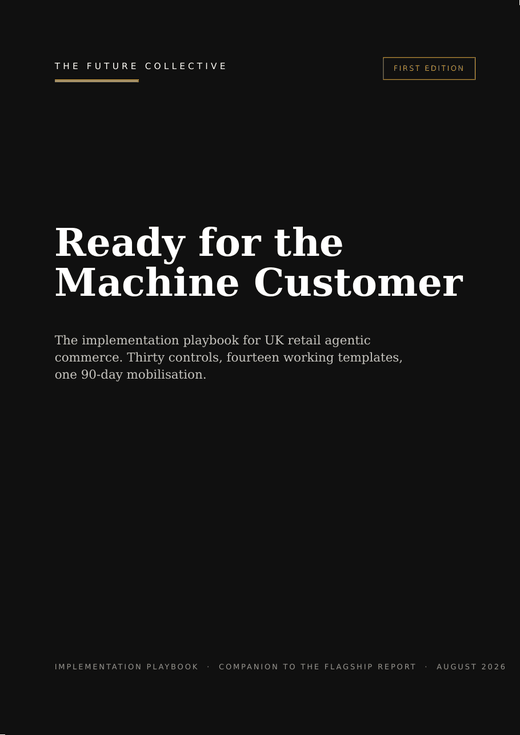
The step-by-step programme behind the fix: thirty controls, fourteen working templates and a 90-day mobilisation, sequenced so a leadership team can run it as their own. First edition, designed PDF.
Your shelf's full remediation blueprint, generated from the recorded wave evidence and run with your team: the complete sequence, owners, and done defined as what the next probe will measure. Scoped and priced per client.
Usually begins with your retailer's evidence pack.
See what you are buying
Real pages from the current editions, and the full contents of each. Not ready to buy? The twelve-page executive sampler is free.
The Machine Customer Flagship research report · 46 pages
What is inside, in full
An executive summary, then eleven chapters:
The arrival of the machine customer
The infrastructure is arriving first
What the UK evidence says
The five ways the machine shelf breaks
The medicines case
The commercial consequences
Trust, law and accountability
The Agentic Commerce Readiness Model
The board agenda
Four plausible market futures
Conclusion
Appendices cover the methodology and evidence boundaries, definitions, the publication and claim protocol, and all sources. Five designed figures and eighteen tables, built from the recorded wave data.
46-page designed PDF · first edition, August 2026 · licensed for defined internal organisational use · instant download after checkout, with the link kept for re-download · VAT invoice by email.
Ready for the Machine Customer Implementation playbook · 69 pages
What is inside, in full
Four parts, sequenced as a programme:
Diagnose the machine shelf: establish what is true before choosing what to build
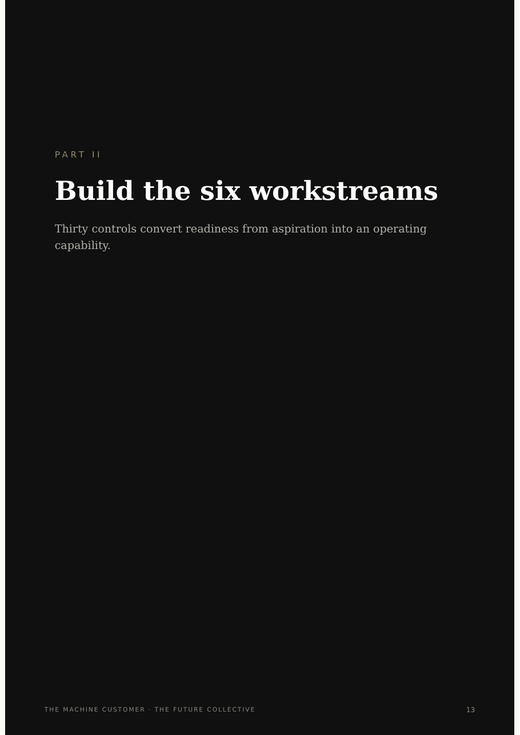
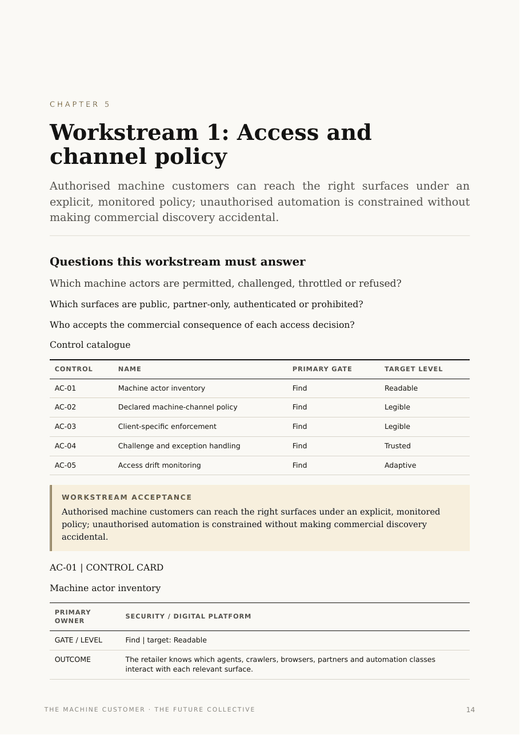
Build the six workstreams: thirty controls, each with an owner, gate, target level and acceptance test
Mobilise and fund: the controlled 90-day mobilisation and the funding decision
Use the toolkit: fourteen copy-ready templates for the evidence pack and operating rhythm
The thirty controls span access and channel policy, product identity and offer truth, policy and safety, transaction and authority, measurement, and governance. Each control card states its outcome, owner, gate and target maturity level, so a leadership team can assign and audit the work.
69-page designed PDF · first edition, August 2026 · licensed for defined internal organisational use · instant download after checkout, with the link kept for re-download · VAT invoice by email.